case file 02
Founding Engineer · 1 of 3 on the founding team · Jun 2023 – Sep 2026
P2P.me
A decentralized on/off ramp: USDC to local money and back, fast enough to pay at any store, without bank-freeze worries. Taken from idea to live platform by a founding team of three.
company metricsthe team I helped build
- users
- 250K
- monthly active users
- 30K+
- cumulative volume
- $60M+
- countries
- 15+
hats worn
- UX/UI
- Frontend
- Backend
- Deploys
- Prod maintenance
- Distribution
Assembled by a founding team of 3
The problem
Getting between crypto and local money usually means a centralized exchange: KYC queues, slow withdrawals, and bank accounts frozen over flagged peer-to-peer trades.
P2P.me is a decentralized fiat on/off ramp. People swap USDC and their local currency directly with merchants, with the trade enforced by smart contracts on Base, so it’s fast enough to pay at a shop counter.
My role
Founding engineer, one of three on the founding team alongside two co-founders. We built it from an early-stage idea into a live platform.
I designed the app (UX flows and UI) and contributed hands-on from there: frontend and backend development, deployment and production maintenance.
- Design
- Frontend
- Backend
- Deployment
- Production maintenance
- Distribution
What I designed
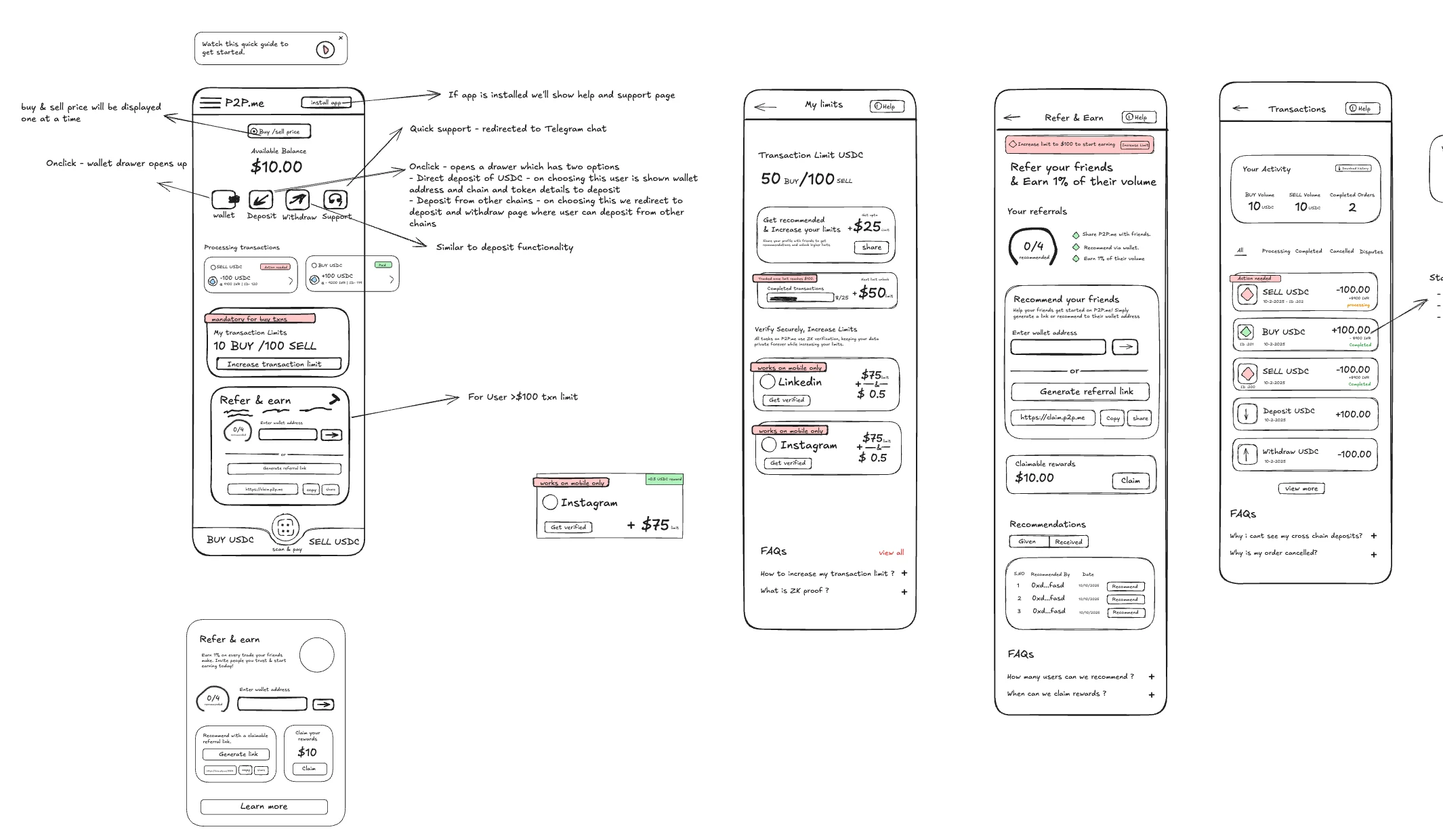
The app’s UX flows and UI, wireframes first. Each screen starts as a sketch with its behaviour written next to it, so engineering gets the logic along with the layout.
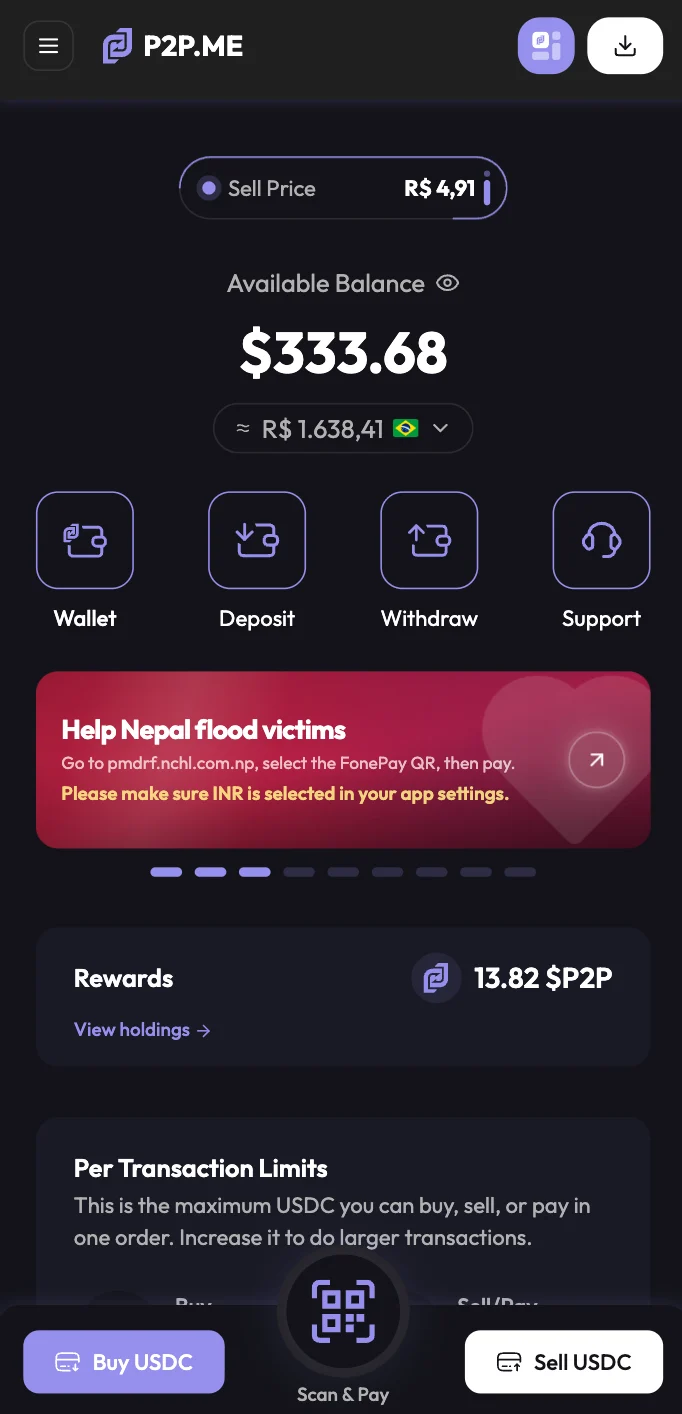
The home screen shows one price at a time (buy or sell), the balance, and four actions: wallet, deposit, withdraw and support, which goes straight to a Telegram chat. Below that are processing orders and your transaction limits. My Limits turns verification into rewards: link LinkedIn or Instagram through a zero-knowledge proof and your limit goes up, with no data stored. Refer & Earn pays 1% of friends’ volume, and Transactions groups orders by status, with the ones that need action pinned on top.
- Home and quick actions
- Limits via ZK verification
- Refer & Earn
- Transactions by status
- Cross-chain deposits
What I built
Hands-on development across the platform: the user app (React, Vite, Tailwind), the protocol’s Solidity contracts (Hardhat, OpenZeppelin, on Base), the landing site (Astro) and a funds-recovery tool (Next.js, viem).
In the contracts I worked on onchain identity and trust: zero-knowledge Aadhaar verification, so a user can prove they’re a verified Indian resident without revealing who they are, and the recommendation system, where users vouch for each other and build reputation. In the app I shipped the token launch countdown and sale flows, and bank-freeze protection for Indian users.
- User app
- Smart contracts
- ZK Aadhaar verification
- Reputation system
- Landing site
- Funds recovery
How it shipped
Deployment and production maintenance, keeping a live platform running as it grew.
Live money finds edge cases staging doesn’t, so shipping included staying on call: contract fixes, order event updates for the indexer, and releases through reviewed pull requests. When we moved users off the old app, I built a separate recovery tool so anyone with funds there could still get them out.
- Production fixes
- Order event indexing
- Funds recovery tool
- Netlify deploys
How it grew
I contributed to distribution and marketing campaigns across multiple countries.
Company outcomes I was part of: 250K users, 30K+ monthly active users, $60M+ cumulative transaction volume, 15+ countries and ~$8M raised.
My part was the product surface of each campaign. I built the $P2P token launch countdown and sale banners across the app and landing site, Spanish-language support for Latin American users, the bank-freeze protection campaign for India, and a merchant recruitment banner to grow the supply side.
- 250K users
- 30K+ MAU
- $60M+ cumulative volume
- 15+ countries
- ~$8M raised
What I learned
On a team of three, there’s no “not my job”. I went from wireframes to Solidity to landing pages in the same week, and that range is what let us move fast.
Trust is the product in money apps. Most of what we built (ZK verification, reputation, limits) exists to make strangers safe trading with each other, and every bug fix in production was really a trust fix.
Distribution has to be built like a feature. The campaigns that worked lived inside the app, not just around it.